Updated
How does a NeoGraft hair transplant work?
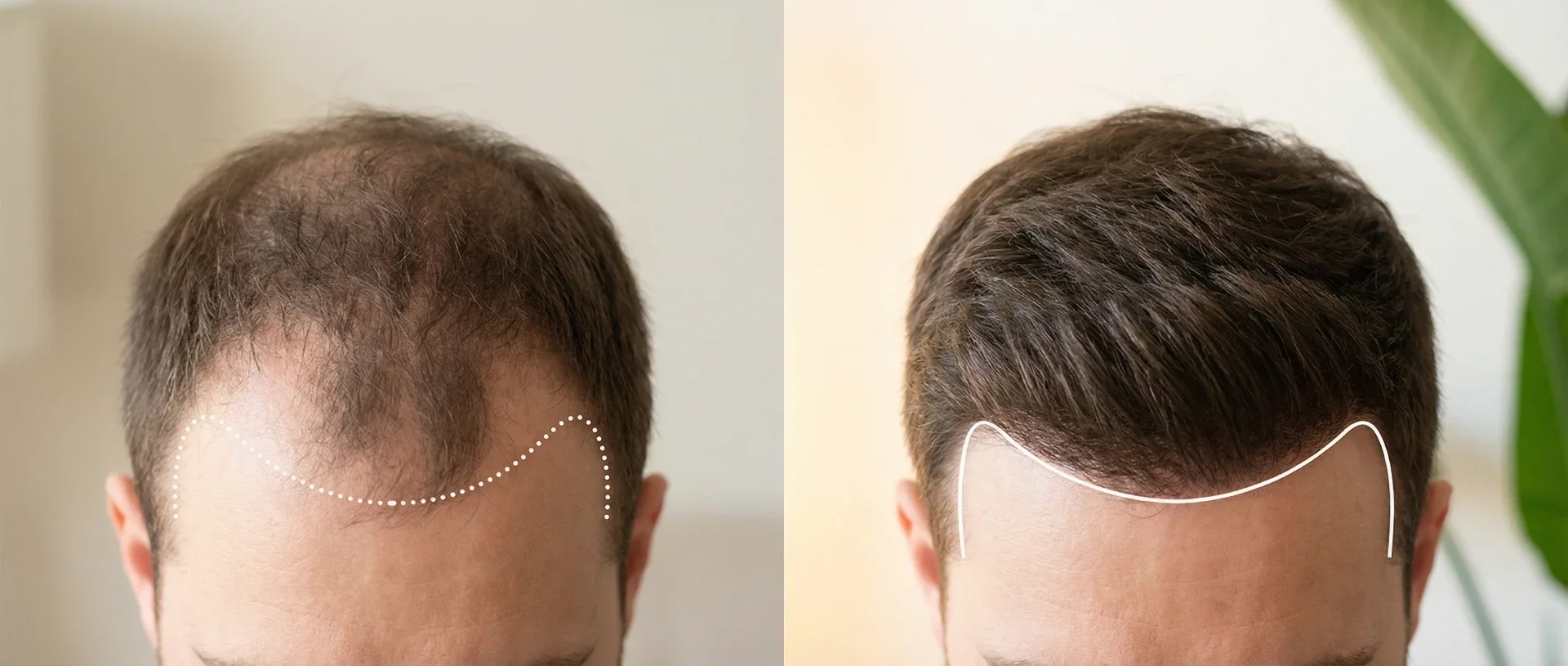
A hair transplant moves your own follicles from the back and sides of the scalp, where hair is genetically resistant to DHT, into areas that have thinned. At Aliestetic in Miami we use NeoGraft, a device cleared by the FDA for suction assisted follicular unit extraction and reimplantation. Instead of removing a strip of scalp, follicular units are harvested one at a time, so there is no linear scar across the back of the head, only tiny dot scars that fade. Transplanted follicles keep their original genetic programming, which is why the result is usually described as permanent, although hair loss can continue in the untreated areas around them. Growth is not immediate. Most transplanted hairs shed within the first weeks, new growth becomes visible around month three, and final density is judged between nine and twelve months. A transplant does not stop the underlying hair loss, so a medical plan usually runs alongside it.
Benefits of Real and Lasting Results
Cutting-Edge Technology
Automated and highly precise FUE procedure.
No Visible Marks
Leaves no linear scars, maintaining a clean aesthetic.
Permanence
Natural results that last forever.
Fast Recovery
The process involves minimal pain and a quick return to your activities.
Universal
It is the ideal solution for both men and women suffering from hair loss.

How Does It Work?
- A thorough medical evaluation and a personalized hairline design are performed.
- Follicles are carefully extracted, one by one, from the donor area.
- Implantation is automated, ensuring optimal direction and density for a natural look.
- Includes postoperative follow-up and specialized care by the Aliestetic team.
Duration per session
Between 4 and 6 hours, depending on the number of follicles to be transplanted.
Growth is visible starting from the 3rd month, reaching the final result between 9 and 12 months.
Real transformations
“I regained my confidence and I look younger. No one notices it's a transplant because it looks natural!” (Andrés M., 41 years old).
Results are individual: one patient’s experience does not represent what any given person should expect.
Book your appointment nowQuick facts
- Anesthesia
- Local. You are awake.
- Technique
- FUE with NeoGraft, a device cleared by the FDA for suction assisted follicular extraction and reimplantation.
- Scarring
- No linear scar. Small dot scars across the donor area.
- First visible growth
- Around month three.
- Final result
- Assessed between month nine and month twelve.
- Locations
- Aliestetic, Miami and Naples, Florida.
On this page1 / 10What a hair transplant actually does
- What a hair transplant actually does
- NeoGraft compared with manual FUE
- The question most clinics avoid
- Whether you are a candidate is mostly about the donor area
- Hair loss in women
- Curly and afro textured hair
- Beard, eyebrows and repair cases
- PRP, exosomes and the regulatory reality
- What happens after, honestly
- Getting evaluated
Every year of untreated androgenetic alopecia is donor hair that miniaturizes and follicles that close permanently. The useful conversation is what you still have to work with, not which device is trendiest.
Aliestetic runs its hair restoration program at the Miami and Naples centers using NeoGraft, an FDA-cleared follicular unit extraction system for suction assisted extraction and reimplantation. The evaluation, the graft harvesting and preparation and every follow up visit happen at our centers. Florida does not allow the recipient site incisions to be delegated to unlicensed personnel, so ask us who makes them and what license that person holds. You get the name at the consultation, before you book anything.
What a hair transplant actually does
The hair at the back and sides of your head carries a lower sensitivity to dihydrotestosterone, the…
The hair at the back and sides of your head carries a lower sensitivity to dihydrotestosterone, the hormone that drives pattern hair loss, which is why men bald on the crown still have a full band above the neck at seventy. A transplant harvests follicular units from that stable zone and places them into thinned areas, where they keep behaving like donor hair. That principle hasn’t changed in decades; what changed is how the follicles are removed. Strip surgery, or FUT, removes a band of scalp and leaves a linear scar; FUE removes each follicular unit individually through a punch smaller than the tip of a pen, and NeoGraft assists this second method with pneumatic suction so the graft spends less time out of the body.
NeoGraft compared with manual FUE
What matters is transection, the rate at which follicles get damaged during extraction. Published…
What matters is transection, the rate at which follicles get damaged during extraction. Published comparisons place device assisted systems in the middle: better than manual FUE in inexperienced hands, not better than manual FUE from someone who has done thousands of cases. The suction genuinely reduces graft handling and desiccation in long sessions. What no device does is design your hairline or judge how much donor supply to spend today versus preserve for later. That is a judgment call made by a person; choose the person first.
The question most clinics avoid
Ask directly: who performs each part of my procedure, and what license do they hold. In Florida…
Ask directly: who performs each part of my procedure, and what license do they hold. In Florida, creating the recipient sites cannot be delegated to unlicensed personnel; graft preparation can involve trained staff under physician supervision, and that is normal. What is not normal is a clinic that cannot tell you, by name, who is holding the punch. “Hair transplant technician” is not a protected credential and requires no specific school, exam or license. Ask about the individual.
Whether you are a candidate is mostly about the donor area
A consultation should include an actual look at your donor zone under magnification: density…
A consultation should include an actual look at your donor zone under magnification: density, caliber, and whether the donor hair is itself miniaturizing. Two things disqualify people most often: insufficient or unstable donor supply, since a transplant is a redistribution and nothing is created, and loss still moving fast in someone young, where transplanting the hairline today can look strange in five years once the hair behind it disappears. Saying no is part of a real evaluation.
Hair loss in women
Women are transplanted far less often than they are told they can be. In diffuse patterned alopecia…
Women are transplanted far less often than they are told they can be. In diffuse patterned alopecia the occipital donor band stays dense and stable, so harvesting is viable; in diffuse unpatterned alopecia, thinning spreads across the entire scalp including the donor zone, so grafts are already programmed to thin, and reported figures put a majority of women here. Female hair loss also has a longer list of treatable causes to rule out first: thyroid disorders, iron deficiency, postpartum shedding, traction from tight styles.
Curly and afro textured hair
This deserves its own technique, not the same protocol with a smaller punch. Keloid formation is…
This deserves its own technique, not the same protocol with a smaller punch. Keloid formation is more common in patients of African descent and has to be discussed before the first extraction, not after. FUE is generally preferred over strip surgery in keloid prone patients since it avoids the linear wound, though no technique makes the risk zero. The upside: tightly coiled hair provides excellent coverage per graft.
Quick answer
Can afro textured hair be transplanted without damaging the follicle? Yes, with a technique adapted to the follicle. Afro textured follicles curve under the skin in a C or J shape that is invisible at the surface, so a standard straight punch cuts through them. The literature reports transection rates far above those seen in straight hair when standard tools are used, and far lower when curved, appropriately sized punches and shallower entry angles are used. Keloid history also has to be discussed openly before anyone touches the scalp.
Beard, eyebrows and repair cases
The same extraction principle is used for facial hair: beard restoration fills patchy areas and…
The same extraction principle is used for facial hair: beard restoration fills patchy areas and connects a jawline, and eyebrow work is the most demanding of all since each hair must be laid nearly flat at a direction that changes across the brow, with density deliberately conservative because an overfilled eyebrow reads as artificial.
Repair cases have become common in Miami, largely from packaged procedures done abroad: a hairline too low or too straight, pluggy front-row grafts, wrong angles, depleted donor areas. Softening the line and repositioning the worst placed grafts usually helps, but the donor supply was already spent once, and most surgeons want at least twelve months before judging what really grew.
PRP, exosomes and the regulatory reality
Platelet rich plasma is prepared from your own blood and has the larger body of randomized evidence…
Platelet rich plasma is prepared from your own blood and has the larger body of randomized evidence in androgenetic alopecia, with improvements in density and shaft diameter. It is not permanent, requires maintenance, and cannot revive a follicle that is already gone. Exosomes are marketed aggressively, but no exosome product has been approved by the FDA for aesthetic or hair use in the US: the agency issued a public safety notification after patients were hospitalized following unapproved exosome treatments, and sent warning letters to manufacturers and clinics. Ask what the product is, where it comes from and its regulatory status, in writing.
What happens after, honestly
Transplanted hairs shed within the first weeks, which alarms almost everyone and is expected: the…
Transplanted hairs shed within the first weeks, which alarms almost everyone and is expected: the follicle stays, the shaft falls out and regrows on its own cycle. New growth becomes visible around month three, thickens through months six to nine, and is judged between month nine and twelve. A transplant also does not stop the underlying process: native hair around your grafts can keep thinning, which is how someone ends up with a well built hairline and a new gap behind it. The medical plan for the hair you still have belongs in the same conversation as the surgery.
Getting evaluated
Consultations happen at our Miami and Naples locations, with virtual consultations available if you…
Consultations happen at our Miami and Naples locations, with virtual consultations available if you are traveling in. Contact us here to book. If you are also planning body work, our recovery hub covers the post operative side, and our wellness and recovery protocol is the in house circuit patients use around procedures.
Frequently asked questions
Is NeoGraft better than manual FUE?
It is a different way of harvesting, not a better result by itself. NeoGraft uses pneumatic suction to extract and hold follicular units, which reduces handling and speeds up long sessions. Manual FUE gives the operator direct tactile feedback on every graft. Published comparisons put automated systems at higher transection rates than manual FUE performed by a very experienced surgeon, and lower than manual FUE performed by an inexperienced one. The operator matters more than the device.
Who actually performs the procedure, a doctor or a technician?
This is the question to ask every clinic in Miami, including us. Under Florida rules, making the recipient site incisions is not a delegable act and cannot be performed by unlicensed personnel. Graft preparation and some extraction steps can be handled by trained staff under physician supervision. At your consultation you should be told by name who does each step and what license they hold. If a clinic will not answer that plainly, walk.
Will I have a scar?
Not the linear scar left by strip surgery. FUE leaves hundreds of small round dot scars across the donor area, usually a fraction of a millimeter each. They are hard to see once the hair grows to a short buzz length, but they exist, and if you shave your head to the skin they can become visible under direct light.
When will I see results?
Most transplanted hairs shed in the first weeks, which is expected and not a failure. New growth generally starts to show around the third month, thickens through months six to nine, and the final result is evaluated between nine and twelve months. Anyone promising a visible result in eight weeks is describing something that does not happen biologically.
Can women get a hair transplant?
Some can, many cannot, and the difference is the donor area. Women with diffuse patterned alopecia keep a stable, dense band at the back and sides and may be candidates. Women with diffuse unpatterned alopecia are thinning everywhere, including the donor zone, so harvesting from it gives poor yield and can worsen the appearance. Reported figures suggest more than half of women fall into the second group. Female hair loss also has more medical causes to rule out first, from thyroid disease to iron deficiency.
Does it work on curly and afro textured hair?
Yes, with a technique adapted to the follicle. Afro textured follicles curve under the skin in a C or J shape that is invisible at the surface, so a standard straight punch cuts through them. The literature reports transection rates far above those seen in straight hair when standard tools are used, and far lower when curved, appropriately sized punches and shallower entry angles are used. Keloid history also has to be discussed openly before anyone touches the scalp.
I had a transplant abroad and it looks bad. Can it be fixed?
Often, partially. Repair work usually means softening a hairline that was placed too low or too straight, camouflaging pluggy grafts with single hair units, and sometimes extracting misplaced grafts and reusing them. What limits repair is donor supply, since it was already spent once. Most surgeons wait at least twelve months after the original procedure before judging what actually grew and what did not.
Are exosomes better than PRP for hair?
The honest answer is that exosomes are the less established of the two in regulatory terms. No exosome product is approved by the FDA for aesthetic or hair use in the United States, and the agency has issued warning letters and a public safety notification about unapproved exosome products. Platelet rich plasma is prepared from your own blood and has a larger body of randomized evidence in androgenetic alopecia, with effects that fade without maintenance. Neither one replaces a transplant when follicles are already gone.
Does a transplant stop my hair loss?
No. It relocates hair, it does not switch off the genetic process. The native hair around the grafts can keep thinning, which is how people end up with an island of transplanted hair surrounded by loss. That is why a medical plan for the hair you still have is discussed at the same visit as the surgery.
How long is a session and what is recovery like?
Sessions typically run four to six hours depending on how many follicular units are planned, under local anesthesia, with you awake. Expect a tender donor area, small crusts at the recipient sites for roughly a week, and some swelling in the first days. Most people return to desk work quickly and avoid gym, sun, hats that rub and swimming for the period the clinical team specifies.
Still not sure you are a candidate?
That is what the first consultation is for. It is free, there is no obligation, and you can come to Miami or start by video if you are travelling in.