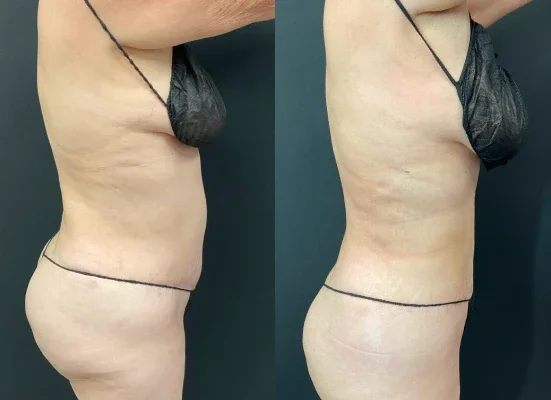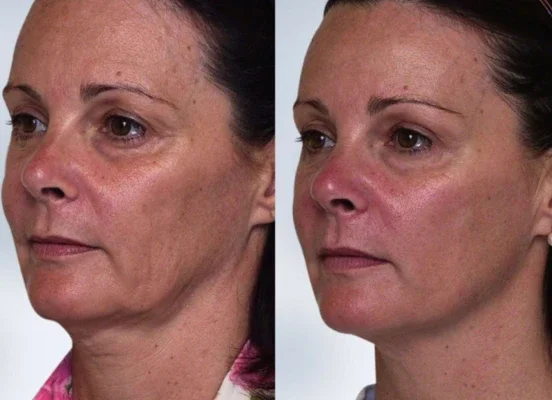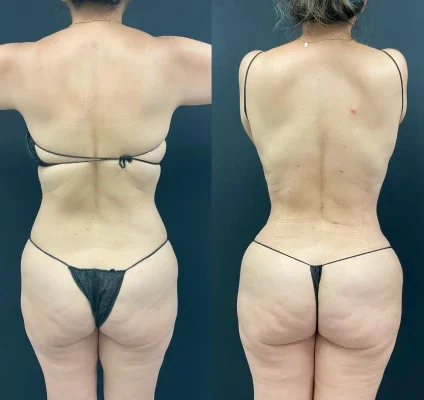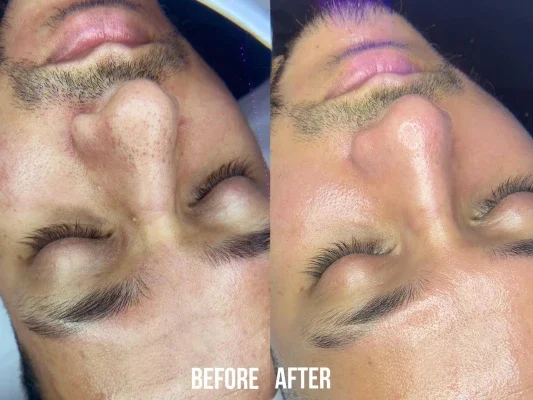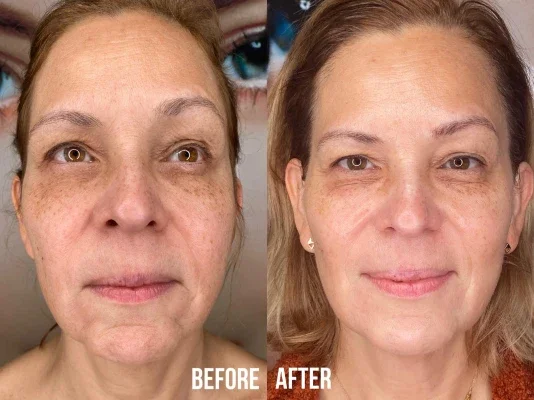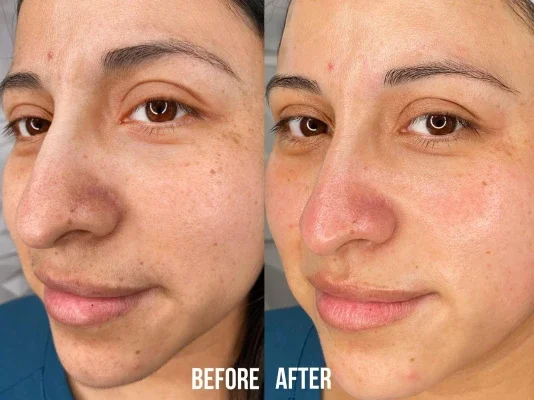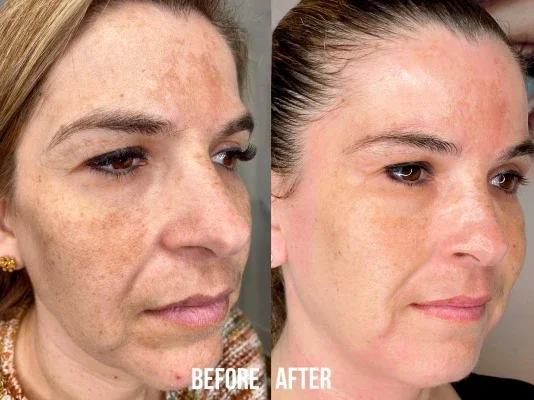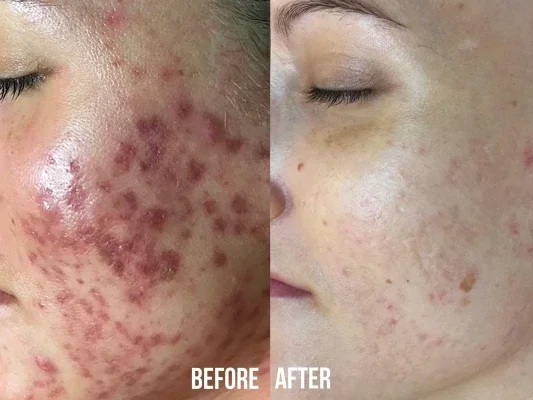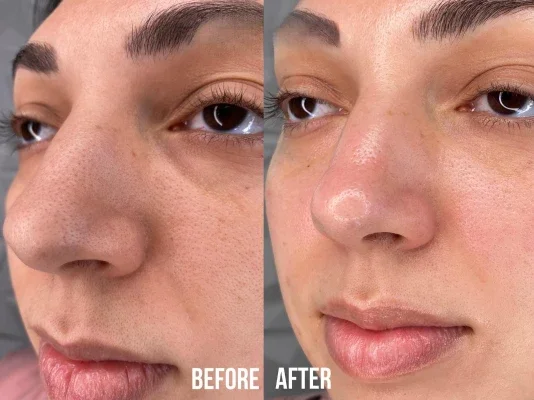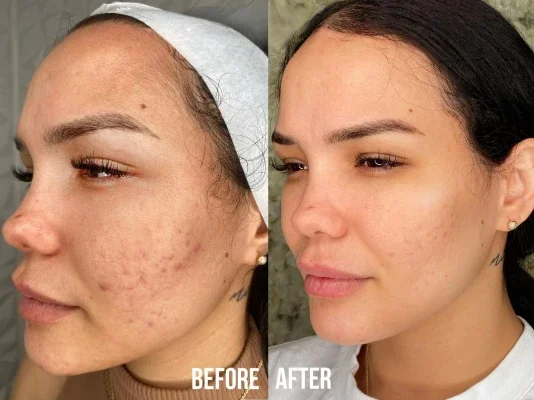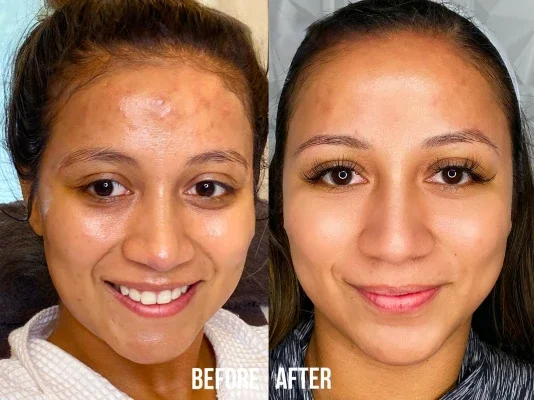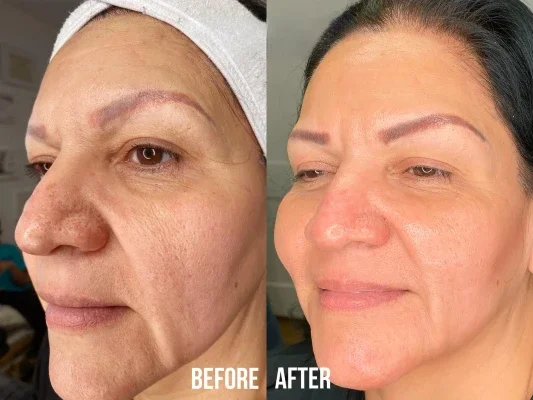
“My skin had sunspots and a dull tone. After the IPL, everything looked more even and bright.” (Daniela R., 42 years old).
Visible benefits from the first sessions
- Decreases sunspots and pigmentation.
- Reduces redness, broken capillaries, and rosacea.
- Improves overall skin texture.
- Evens out skin tone without damaging the surface.
- Fast procedure, with no downtime.
How does it work?
- IPL technology that emits light pulses onto the skin.
- The light is absorbed by pigments and dilated vessels.
- These fragment and are naturally eliminated by the body.
- Stimulates collagen and cell renewal.
- Duration: 30–45 minutes.
- Results: visible from the first session, optimal after 3–5 sessions.
Quick facts
- Sessions
- A series spaced a few weeks apart, number defined after in person assessment
- Session time
- Roughly 20 to 45 minutes depending on the area
- Downtime
- Redness for hours, then darkened spots that flake over one to two weeks
- When you see change
- After the crusting lifts, with results building across the series
- Best for
- Solar lentigines, sun damage, diffuse redness, telangiectasia, erythema of rosacea
- Not for you if
- Hormonal melasma, Fitzpatrick V and VI in most devices, recent tan, pregnancy, recent isotretinoin
On this page1 / 8What is an IPL photofacial, and why is it not a laser?
Most people who ask about an IPL photofacial want one of two things: the brown spots that arrived after years of Florida sun, or the flush and fine red vessels around the nose and cheeks. IPL is a real tool for both, and it is also one of the treatments where the honest answer for a particular face is sometimes no, often enough in South Florida that it belongs near the top of this page. Aliestetic is an aesthetic center with locations in Miami and Naples, and IPL is performed in house.
What is an IPL photofacial, and why is it not a laser?
IPL stands for intense pulsed light. The device is a flashlamp emitting polychromatic light, many wavelengths at once across a broad band, where a laser emits one coherent wavelength. Because IPL starts wide, cut-off filters remove the wavelengths not wanted for a given job. Change the filter and settings, and the same handpiece is steered toward brown pigment or toward blood vessels, so the device is only as good as the person choosing filter, fluence and pulse structure for your skin. IPL systems are typically FDA cleared through the 510(k) route, meaning substantially equivalent to a device already on the market, not the same as FDA approved.
IPL stands for intense pulsed light. The device is a flashlamp emitting polychromatic light, many wavelengths at once across a broad band, where a laser emits one coherent wavelength. Because IPL starts wide, cut-off filters remove the wavelengths not wanted for a given job. Change the filter and settings, and the same handpiece is steered toward brown pigment or toward blood vessels, so the device is only as good as the person choosing filter, fluence and pulse structure for your skin. IPL systems are typically FDA cleared through the 510(k) route, meaning substantially equivalent to a device already on the market, not the same as FDA approved.
How does the light actually remove a spot?
The principle is selective photothermolysis. Chromophores absorb light strongly at particular wavelengths: melanin, which gives a sun spot its color, and hemoglobin, which fills the dilated vessels behind redness. Deliver those wavelengths in a pulse short enough that heat stays in the target, and you damage it while sparing surrounding skin. Damaged pigment rises and sheds; damaged vessel walls collapse and the body clears them. Histology studies also describe new collagen formation over time, why the treatment is often called photorejuvenation rather than just spot removal.
The principle is selective photothermolysis. Chromophores absorb light strongly at particular wavelengths: melanin, which gives a sun spot its color, and hemoglobin, which fills the dilated vessels behind redness. Deliver those wavelengths in a pulse short enough that heat stays in the target, and you damage it while sparing surrounding skin. Damaged pigment rises and sheds; damaged vessel walls collapse and the body clears them. Histology studies also describe new collagen formation over time, why the treatment is often called photorejuvenation rather than just spot removal.
What is IPL genuinely good at?
Solar lentigines, the flat brown spots people call sun spots or age spots (the classic IPL target). General sun damage and mottled tone across the cheeks, chest and hands, where no single spot stands out but the tone is uneven. Facial redness and visible vessels: a systematic review of IPL in rosacea found it effective for telangiectasia and, to a lesser degree, background erythema, though it is not a cure for the underlying chronic condition. Poikiloderma of Civatte, the reddish brown neck and chest mottling that spares the shaded area under the chin.
Solar lentigines, the flat brown spots people call sun spots or age spots (the classic IPL target). General sun damage and mottled tone across the cheeks, chest and hands, where no single spot stands out but the tone is uneven. Facial redness and visible vessels: a systematic review of IPL in rosacea found it effective for telangiectasia and, to a lesser degree, background erythema, though it is not a cure for the underlying chronic condition. Poikiloderma of Civatte, the reddish brown neck and chest mottling that spares the shaded area under the chin.
What IPL does not do is tighten loose skin, fill a line, resurface a scar, or fix pigment sitting deep in the dermis. Those are different mechanisms and different treatments.
Why IPL can make melasma worse
Melasma reacts badly to heat, and IPL delivers heat by design. That is the mechanism, not a side effect, and it is the part most clinics leave off the page.
Melasma reacts badly to heat, and IPL delivers heat by design. That is the mechanism, not a side effect, and it is the part most clinics leave off the page.
Melasma is not sun damage. It is a chronic pigmentary condition with a hormonal, vascular and inflammatory component. The published picture is consistent: light and laser treatments in melasma frequently produce rebound hyperpigmentation, relapse and darkening within a few months, and a darker skin type raises the risk further.
So if your pigment is melasma, IPL is not the first thing to try, and in some cases it is the thing most likely to set you back. The approaches with better risk to benefit are less dramatic and more patient: rigorous photoprotection including visible light with tinted, iron oxide sunscreens; topical therapy, hydroquinone regimens and triple combination creams under supervision; addressing the driver, since hormonal contraception, pregnancy and thyroid conditions sit behind melasma for many patients; gentle peels and microneedling as adjuncts; and oral tranexamic acid, a prescription decision made by a doctor, not something a med spa hands out.
That is probably not what you hoped to read if you came here searching for a fast fix, but it is what the evidence supports: a treatment that darkens your face for six months is not a bargain.
How skin tone changes the decision
IPL aims at melanin, and your skin also contains melanin. The entire safety question sits in that sentence.
IPL aims at melanin, and your skin also contains melanin. The entire safety question sits in that sentence.
The Fitzpatrick scale describes how skin behaves in sun, from type I, which burns and never tans, through type IV, olive to moderate brown skin that rarely burns and is extremely common among our patients, to type VI, deeply pigmented skin. As the number rises, more melanin sits in the epidermis absorbing energy that was never meant for it, and the consequences are not cosmetic disappointments: burns, blistering, hypopigmentation, post inflammatory hyperpigmentation and, in severe cases, scarring.
In practice, IPL is generally comfortable in types I through III, requires conservative settings at type IV, is not recommended in type V for most devices, and is contraindicated in type VI. Post inflammatory hyperpigmentation is already the dominant complaint we hear from Latino and Afro Caribbean patients in Miami; creating more of it with the wrong device is the opposite of the job.
What we do instead: assess your phototype in person, ask about your history of scarring and dark marks, and where IPL is on the edge perform a test patch first. Where it is not appropriate, alternatives worth discussing include long pulsed 1064 nm Nd:YAG devices, which bypass much of the epidermal melanin, peels formulated for ethnic skin, microneedling, and a disciplined topical routine.
Sun, the session, and aftercare
A recent tan is a contraindication, not a preference: tanned skin has more epidermal melanin available to absorb energy, raising the risk of a burn, so if you spent the weekend on a boat, your session moves. Daily sun protection afterward is part of the treatment too, since cleared spots can come back.
A recent tan is a contraindication, not a preference: tanned skin has more epidermal melanin available to absorb energy, raising the risk of a burn, so if you spent the weekend on a boat, your session moves. Daily sun protection afterward is part of the treatment too, since cleared spots can come back.
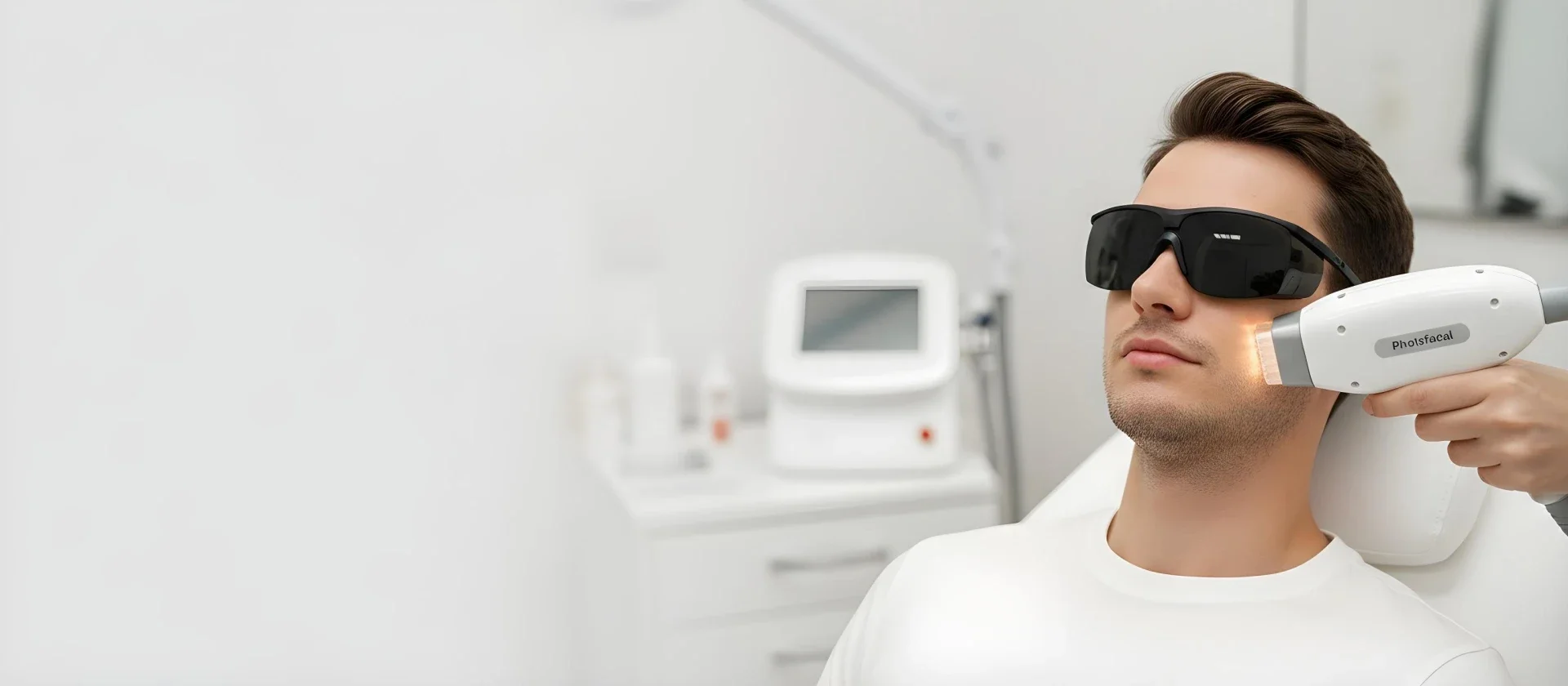
During the session your eyes are shielded, a cool gel is applied, and each pulse feels like a quick snap of heat, often compared to a rubber band, with a bright flash even through closed eyes. Skin is flushed afterward like a mild sunburn. Treated brown spots darken over the next day or two into a speckled pattern patients describe as coffee grounds (that is the treatment working), and the crusts lift off on their own. Do not help them: picking or exfoliating is a reliable way to trade a brown spot for a longer lasting mark, particularly in darker skin. Vascular results fade over the following weeks rather than crusting.
Who should not have IPL
Beyond skin type and recent tanning, IPL is avoided in pregnancy, within several months of finishing isotretinoin, over active infection or tattoos, and in photosensitive epilepsy. Photosensitizing medications are frequently missed: tetracyclines such as doxycycline, St John’s wort and amiodarone all raise photosensitivity, so bring the complete list, including supplements. Moles or lesions that have changed need evaluation first; IPL diagnoses nothing and should never be used to make an unexplained lesion look better.
Beyond skin type and recent tanning, IPL is avoided in pregnancy, within several months of finishing isotretinoin, over active infection or tattoos, and in photosensitive epilepsy. Photosensitizing medications are frequently missed: tetracyclines such as doxycycline, St John’s wort and amiodarone all raise photosensitivity, so bring the complete list, including supplements. Moles or lesions that have changed need evaluation first; IPL diagnoses nothing and should never be used to make an unexplained lesion look better.
How we decide at Aliestetic
The consultation answers one question honestly: is IPL the right tool for your skin, or is something else safer and more likely to work. Sometimes it is a series of photofacials, sometimes a peel or microneedling instead, sometimes a topical plan and a referral because the pigment is melasma with a hormonal driver that no device outruns. Ask us directly which device we use and what settings we plan for your phototype.
The consultation answers one question honestly: is IPL the right tool for your skin, or is something else safer and more likely to work. Sometimes it is a series of photofacials, sometimes a peel or microneedling instead, sometimes a topical plan and a referral because the pigment is melasma with a hormonal driver that no device outruns. Ask us directly which device we use and what settings we plan for your phototype.
What does an IPL photofacial treat, and when is it the wrong choice?
An IPL photofacial is a broadband light treatment, not a laser. A flashlamp emits polychromatic light across a wide range of wavelengths, and cut-off filters remove the ones that are not wanted, so the remaining light is absorbed preferentially by melanin in sun spots or by hemoglobin inside small dilated vessels. The absorbed light becomes heat, the target is damaged while surrounding skin is largely spared, and the body clears the debris over the following days. At Aliestetic in Miami and Naples, IPL is used mainly for solar lentigines, general sun damage, diffuse redness, telangiectasia and the erythema of rosacea. It is not right for everyone. IPL can trigger a rebound in hormonal melasma and leave it worse than before, and because the light targets melanin, the safety margin narrows sharply at Fitzpatrick IV and most IPL devices are not indicated in Fitzpatrick V and VI. Skin type is assessed in person before anything is scheduled, and results vary from person to person.
Frequently asked questions
Is IPL a laser?
No, and the difference matters. A laser emits one coherent wavelength. IPL emits polychromatic broadband light from a flashlamp, and filters cut off the wavelengths that are not useful for the target. That is why one IPL handpiece can be steered toward brown spots or toward redness by changing the filter and the settings, and it is also why the operator's judgment matters more than the brand name on the machine.
Can IPL treat melasma?
Sometimes it is used for it, but it is a poor first choice and it can make melasma worse. Reviews of light-based treatment in melasma describe rebound hyperpigmentation, relapse and darkening, and short-term improvement is commonly followed by relapse within a few months. Melasma responds to heat, not only to light, and IPL delivers both. If your pigment is melasma, we would rather start with the treatments that carry the least risk of setting you back.
How do I know if my spots are sun damage or melasma?
Sun spots tend to be discrete, sharply bordered brown marks that appeared one at a time on sun exposed areas. Melasma is usually a larger, blotchy, symmetrical patch across the cheeks, upper lip, forehead or jawline, it often started during pregnancy or after starting hormonal contraception, and it gets worse in summer. The distinction changes the entire plan, so it is made in person and, where there is any doubt, with a dermatologist.
Is IPL safe on brown and dark skin?
It depends on where you fall on the Fitzpatrick scale. At Fitzpatrick IV, which covers a large share of our patients, IPL can be done but the safety margin is narrower and settings must be conservative with a test patch first. At Fitzpatrick V and VI, most IPL devices are simply not indicated, because the melanin in the skin itself competes with the target and the risk of burns, blistering, hypopigmentation and post inflammatory hyperpigmentation rises. In that case we would rather offer you something else than sell you IPL.
What is the Fitzpatrick scale?
It is a six point way of describing how skin responds to sun, not a description of ethnicity. Type I always burns and never tans, type III is light brown skin that burns sometimes and tans gradually, type IV is olive to moderate brown skin that rarely burns and tans easily, type V is brown skin that very rarely burns, and type VI is deeply pigmented skin. Light based devices are calibrated around this scale because the amount of melanin in the epidermis changes how much energy the skin absorbs.
Why do my spots get darker after IPL?
That is the expected sequence, not a complication. Within a day or two treated spots usually darken and take on a speckled look that patients describe as coffee grounds or peppering. Over roughly one to two weeks that crusting lifts and flakes away. Do not scrub it, pick it or exfoliate it, because forcing it off is one of the ways people end up with a mark that lasts longer than the spot did.
How many sessions will I need?
Most protocols for sun damage run a series of sessions spaced a few weeks apart, with the exact number set after we see your skin. Deeper or more diffuse pigment and vascular work usually need more passes than a handful of discrete spots. Anyone who quotes you a number before looking at your face is guessing, and results vary from person to person.
Does an IPL photofacial hurt?
Most people describe a fast snap of heat with each pulse, like a rubber band flicked against the skin, along with a bright flash through closed eyes and eye shields. It is brief and it is tolerable for most patients without anesthesia. Afterwards the skin looks flushed and feels like a mild sunburn for several hours.
Can I get IPL if I have a tan?
No. A recent tan, including a spray free tan from actual sun exposure and a sunbed tan, is a contraindication because the extra epidermal melanin absorbs energy that was meant for the target. In South Florida this is the single most common reason a session gets rescheduled. Plan around your beach weekends, not the other way around.
Who should not have IPL?
Pregnancy, recent isotretinoin, active cold sores or infection in the area, photosensitizing medication including tetracyclines such as doxycycline, St John's wort, amiodarone and some diuretics, photosensitive epilepsy, tanned skin, and unassessed moles or a history of skin cancer in the area without evaluation. Tattoos in the treatment field are avoided. Bring your full medication and supplement list to the consultation and never stop a prescription on your own.
Still not sure you are a candidate?
That is what the first consultation is for. It is free, there is no obligation, and you can come to Miami or start by video if you are travelling in.