
Surgical procedures are performed by an affiliated board-certified plastic surgeon. Aliestetic coordinates your consultation, pre-op and recovery.
Quick facts
- Anesthesia
- Local anesthesia with sedation, or general anesthesia, decided with your surgeon
- Procedure time
- Commonly 30 to 60 minutes, longer if combined with another procedure
- Back to work
- Desk work about five to seven days. Physical or contact-risk work three to four weeks
- Materials
- Solid silicone or a porous material such as polyethylene, chosen based on your anatomy and goals
- Incision options
- Under the chin in the natural crease, or inside the mouth along the lower lip
- First results
- Visible within days, obscured by swelling. Most swelling resolves within a few weeks
- Who operates
- An affiliated plastic surgeon. We give you the name, the Florida license number and the board certification at the consultation, before anything is scheduled
- Where recovery happens
- The Aliestetic recovery program in Miami, following the surgeon's written orders
On this page1 / 9What chin augmentation actually does
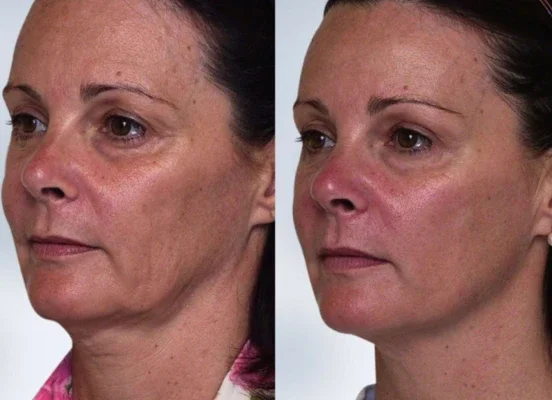
A weak chin reads as a jaw problem even when the jaw itself is fine, because the eye judges the lower face as one unit. Chin augmentation with an implant is one of the most direct ways to correct that without touching bone, and it is often paired with other facial procedures for exactly that reason.
In 2024, ASPS member surgeons performed 5,529 chin augmentation procedures, a stable, consistently requested facial surgery.
Aliestetic does not operate. The surgery is performed by our affiliated plastic surgeon. We coordinate the consultation, the pre-operative workup and run the recovery program at our own Miami location.
What chin augmentation actually does
An implant is placed in front of the chin bone, under the muscle and soft tissue, to add forward projection and, depending on shape, some width along the jawline. It does not reshape the jaw itself, it does not fix a bite problem, and it is a different procedure from an osseous genioplasty, which surgically repositions the actual chin bone rather than placing an implant in front of it. For most patients whose concern is projection rather than a skeletal discrepancy, an implant is the simpler, shorter operation.
An implant is placed in front of the chin bone, under the muscle and soft tissue, to add forward projection and, depending on shape, some width along the jawline. It does not reshape the jaw itself, it does not fix a bite problem, and it is a different procedure from an osseous genioplasty, which surgically repositions the actual chin bone rather than placing an implant in front of it. For most patients whose concern is projection rather than a skeletal discrepancy, an implant is the simpler, shorter operation.
Implant materials
Solid silicone
The most commonly used material. The body forms a thin fibrous capsule around it rather than growing into it, which makes it nonreactive and, if a patient wants a different size later or needs it removed, generally more straightforward to take out.
Porous materials, such as polyethylene
Tissue grows through the pore structure over time, which gives a more fixed, stable position but makes removal or exchange more technical if a revision is ever needed.
Neither material has a meaningfully different overall complication rate in the published literature. The decision usually comes down to your anatomy, how much projection you need, and which material your surgeon has the most experience placing well.
Incision options
An incision under the chin, in the natural skin crease, gives direct access and precise placement, and the resulting scar fades well in most patients. An incision inside the mouth along the lower lip leaves no visible external scar, but passes through the oral cavity, which carries a higher reported infection risk than the external approach. Ask your surgeon which they use routinely and why, rather than assuming the scarless option is automatically the better one for you.
An incision under the chin, in the natural skin crease, gives direct access and precise placement, and the resulting scar fades well in most patients. An incision inside the mouth along the lower lip leaves no visible external scar, but passes through the oral cavity, which carries a higher reported infection risk than the external approach. Ask your surgeon which they use routinely and why, rather than assuming the scarless option is automatically the better one for you.
Am I a candidate?
Good candidates have a chin that sits behind the ideal facial plane relative to the lips and neck, are in stable general health, and have realistic expectations about what an implant changes: projection, not bone structure or bite. Chin augmentation is frequently done alongside submental liposuction, since fat under the chin can obscure a weak jawline as much as lack of projection does, and doing both together often produces a more complete result than either alone.
Good candidates have a chin that sits behind the ideal facial plane relative to the lips and neck, are in stable general health, and have realistic expectations about what an implant changes: projection, not bone structure or bite. Chin augmentation is frequently done alongside submental liposuction, since fat under the chin can obscure a weak jawline as much as lack of projection does, and doing both together often produces a more complete result than either alone.
Anyone with an active dental or gum infection needs that resolved first, since the intraoral incision route in particular depends on a clean oral environment. Smokers face elevated healing risk here as with any surgery involving tissue closure.
How the process runs
Your consultation is in person, with your surgeon assessing your bone structure, your profile and the relationship between your chin, lower lip and neck. Sizing is determined from that exam, sometimes with imaging, not from a size chart.
Your consultation is in person, with your surgeon assessing your bone structure, your profile and the relationship between your chin, lower lip and neck. Sizing is determined from that exam, sometimes with imaging, not from a size chart.
The procedure itself commonly runs thirty to sixty minutes, longer if combined with liposuction or another procedure, and is typically outpatient. You will need someone to drive you home.
Recovery week by week
- 01
Days 0 to 3
Swelling and tightness are heaviest here, along with some difficulty fully opening the mouth. A soft diet is standard, especially with the intraoral incision approach, to protect the healing incision from chewing forces.
- 02
Days 4 to 7
Bruising and swelling begin visibly improving. Most patients feel comfortable resuming low-key public activity toward the end of this window.
- 03
Weeks 2 to 3
Residual swelling along the jawline continues settling, and numbness of the lower lip and chin skin, common from swelling near the nerve that runs close to this area, usually starts improving.
- 04
Weeks 3 to 4
Physical activity and any activity carrying a risk of a blow to the chin can typically resume with your surgeon’s clearance.
- 05
Months 1 to 3
The final position and contour become clear as the last of the swelling resolves.
Real risks
Infection is a genuine risk, more frequently discussed with the intraoral incision because it passes through the oral cavity. Implant shifting or malposition is one of the reasons a real revision rate exists for facial implants, reported somewhat more with unfixed solid silicone than with porous materials that integrate into tissue, though fixation technique matters as much as material choice. Asymmetry, prolonged or occasionally persistent numbness, and a small long-term risk of bone resorption under the implant are part of an honest risk conversation, along with the standard risks of anesthesia.
Infection is a genuine risk, more frequently discussed with the intraoral incision because it passes through the oral cavity. Implant shifting or malposition is one of the reasons a real revision rate exists for facial implants, reported somewhat more with unfixed solid silicone than with porous materials that integrate into tissue, though fixation technique matters as much as material choice. Asymmetry, prolonged or occasionally persistent numbness, and a small long-term risk of bone resorption under the implant are part of an honest risk conversation, along with the standard risks of anesthesia.
What to ask before choosing a surgeon
- Verify the license. The Florida Department of Health Division of Medical Quality Assurance runs a free portal showing license status, registered address and public discipline.
- Confirm board certification with the American Board of Plastic Surgery. Board certified plastic surgeon and cosmetic surgeon are not the same credential.
- Ask which material and incision the surgeon plans for you, and why, based on your exam.
- Ask what happens if the implant needs to be resized, repositioned or removed.
What Aliestetic does, and what your surgeon does
Your surgeon operates. Aliestetic coordinates the consultation and pre-operative workup, and manages your recovery: monitoring the healing incision, timing follow-up visits to your surgeon’s written orders, and being your point of contact in Miami while swelling resolves and your final contour comes into view.
Your surgeon operates. Aliestetic coordinates the consultation and pre-operative workup, and manages your recovery: monitoring the healing incision, timing follow-up visits to your surgeon’s written orders, and being your point of contact in Miami while swelling resolves and your final contour comes into view.
What are chin implants made of, and does the material matter?
Chin implants are most commonly solid silicone, which the body encapsulates in a thin fibrous layer rather than growing into, or a porous material such as polyethylene, which tissue grows through and around. Solid silicone is nonreactive, easy to place and, because it stays encapsulated rather than integrated, easier to remove or exchange later if a patient wants a different size. Porous implants integrate with surrounding tissue for a more fixed, stable position but are more technical to remove if a revision is needed later. Neither material carries a meaningfully different overall complication rate in the literature, and the honest deciding factors are the patient's anatomy, the amount of projection needed and the surgeon's experience with a given material. In 2024, ASPS member surgeons performed 5,529 chin augmentation procedures. At Aliestetic in Miami we coordinate the consultation and the recovery, and the surgery itself is performed by our affiliated plastic surgeon.
Frequently asked questions
How many days of recovery do I need?
Plan on about a week before swelling and bruising are manageable enough to be in public comfortably, though some residual swelling along the jawline can take several weeks to fully settle. Most of the visible change in the first days is swelling, not yet the final shape, which is why early photos of yourself can look more dramatic or less refined than the eventual result.
When can I go back to work?
Desk work is commonly cleared around five to seven days for most patients. Jobs involving physical exertion, contact sports risk, or anything that could result in a blow to the chin need a longer window, generally three to four weeks, because a direct impact on a healing implant is a real concern early on.
Does it hurt?
Most patients describe tightness and pressure around the chin and lower lip rather than sharp pain, along with temporary difficulty fully opening the mouth. Prescription pain control is typically needed only briefly. Numbness of the lower lip and chin skin is common in the first weeks because of swelling around the nerve that exits near the jawline, and it is usually temporary.
What incision is used?
Two approaches are standard. An incision under the chin, in the natural crease, leaves a small external scar that fades well in most patients and gives very direct, precise placement. An incision inside the mouth, along the lower lip, leaves no visible scar but carries a higher reported risk of infection because it passes through the bacteria-rich oral cavity. Your surgeon's experience with each approach matters as much as which one sounds more appealing on paper.
Can the implant shift or need to be removed later?
Implant migration or shifting is one of the reasons this surgery has a real revision rate, more often reported with solid silicone than with porous materials that integrate into surrounding tissue, though placement technique and fixation matter as much as material. Because solid silicone stays encapsulated rather than integrated, it is generally more straightforward to remove or exchange for a different size if you are unhappy with the result or the implant shifts.
How is size decided?
Size is not chosen from a menu the way a shoe size would be. Your surgeon evaluates your existing bone structure, the relationship between your lower lip, chin and neck, and often the rest of your facial proportions, since a chin that projects well on one face can look excessive on another. A chin implant that is sized well complements the jawline instead of announcing itself.
Can it be combined with liposuction under the chin or a face lift?
Combining chin augmentation with submental liposuction is common and often improves the overall jawline result more than either procedure alone, since one adds projection and the other removes fat that was obscuring it. Combining it with a face lift is also done when appropriate for a patient's anatomy and health, decided at an in-person exam.
What are the real risks?
Infection, implant shifting or malposition, asymmetry, numbness that occasionally persists longer than expected, and a small risk of bone resorption under the implant over years are the risks discussed at consultation. Revision surgery, whether for size, position or removal, is a genuine possibility with any facial implant and is part of an honest conversation before you schedule.
Still not sure you are a candidate?
That is what the first consultation is for. It is free, there is no obligation, and you can come to Miami or start by video if you are travelling in.