
Updated

Surgical procedures are performed by an affiliated board-certified plastic surgeon. Aliestetic coordinates your consultation, pre-op and recovery.
Does gynecomastia come back after surgery?
Gynecomastia can recur after surgery, and the pattern is predictable enough to plan around. When the glandular tissue under the areola is removed completely, that specific tissue does not regrow. Recurrence usually traces back to one of three things: gland that was left behind because access was limited, an underlying cause that was never identified and is still active, or significant weight gain filling out the fatty component again. Anabolic steroids, certain prescription medications, heavy alcohol use and untreated hormonal conditions belong in the first conversation, not the last, because operating without addressing an active cause is the situation most associated with a second surgery. At Aliestetic in Miami we coordinate that workup before anything is scheduled. The operation is performed by our affiliated plastic surgeon, and the compression and drainage phase afterward is run at our Miami center.
Benefits of Real and Lasting Results
Flatter Chest Contour
Removes excess glandular tissue and fat for a flatter, more masculine chest profile.
Minimal Scarring
Incisions are placed around the areola edge, where they blend naturally.
Outpatient Procedure
Performed on an outpatient basis with a same-day discharge in most cases.
Compression Recovery
A compression vest supports the new contour during the first weeks.

How is Gynecomastia surgery performed?
- It begins with a medical evaluation to identify the exact source of the pectoral volume.
- Liposuction, glandular resection, or a combination of both techniques is used depending on the diagnosis.
- A minimal incision technique with high aesthetic control is applied.
- The process includes a fast recovery under Aliestetic’s professional follow-up.
Duration per session
1 to 2 hours.
Results are visible from the 2nd week and show progressive improvement up to 3 months.
Real results
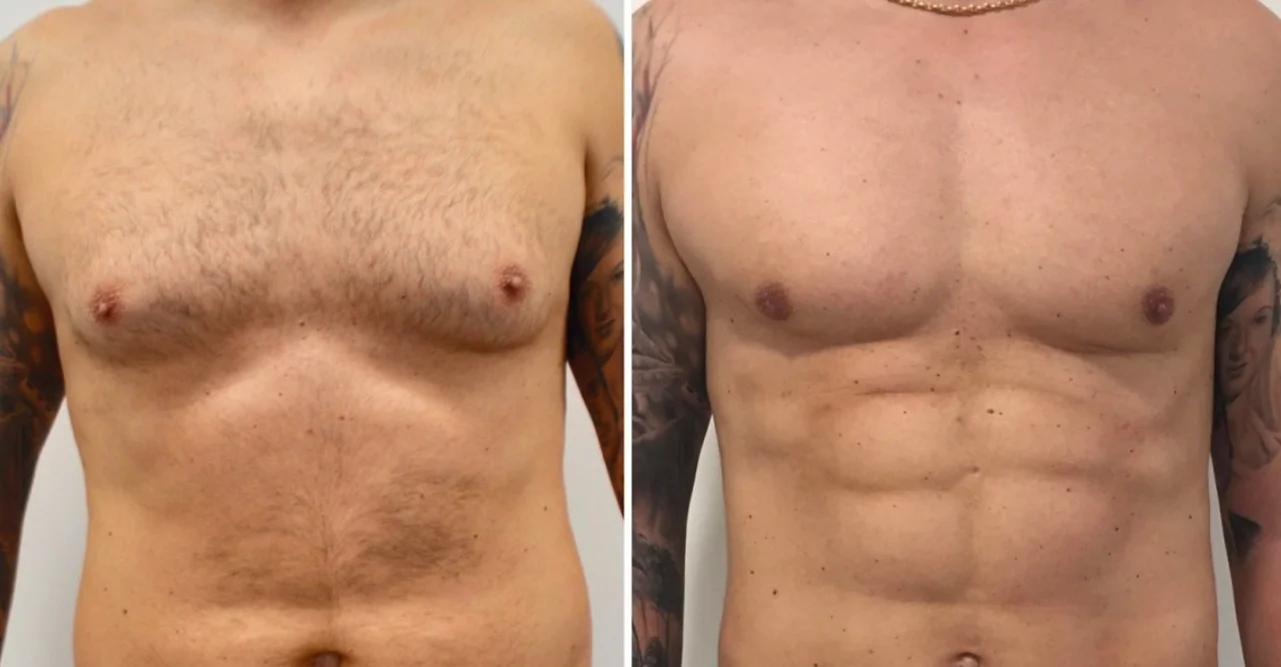
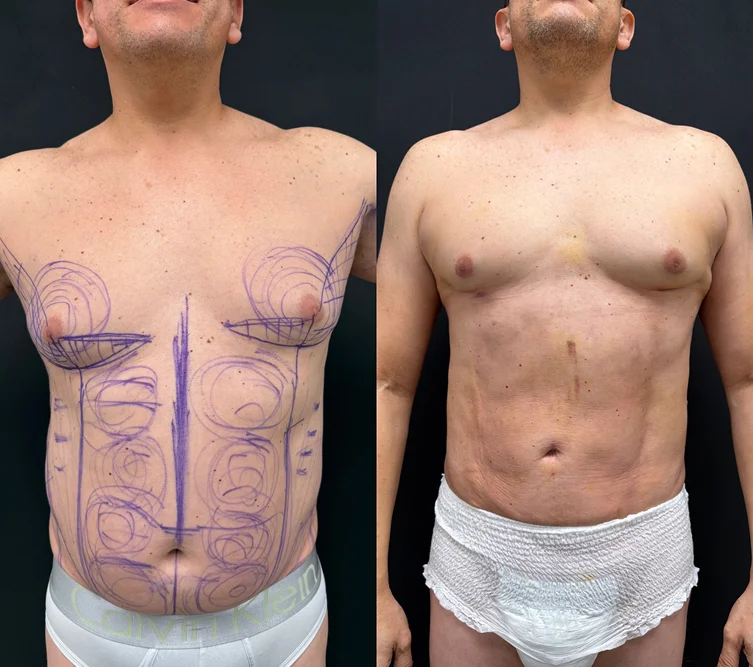
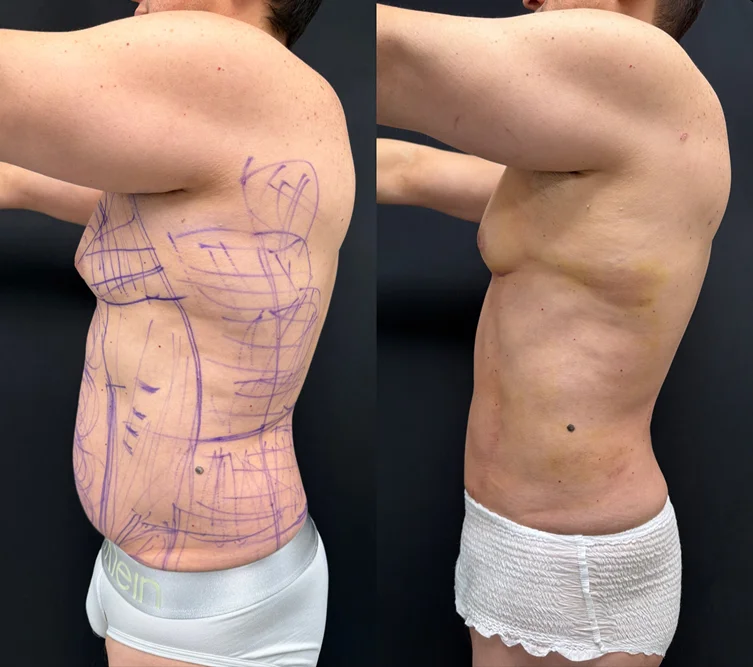
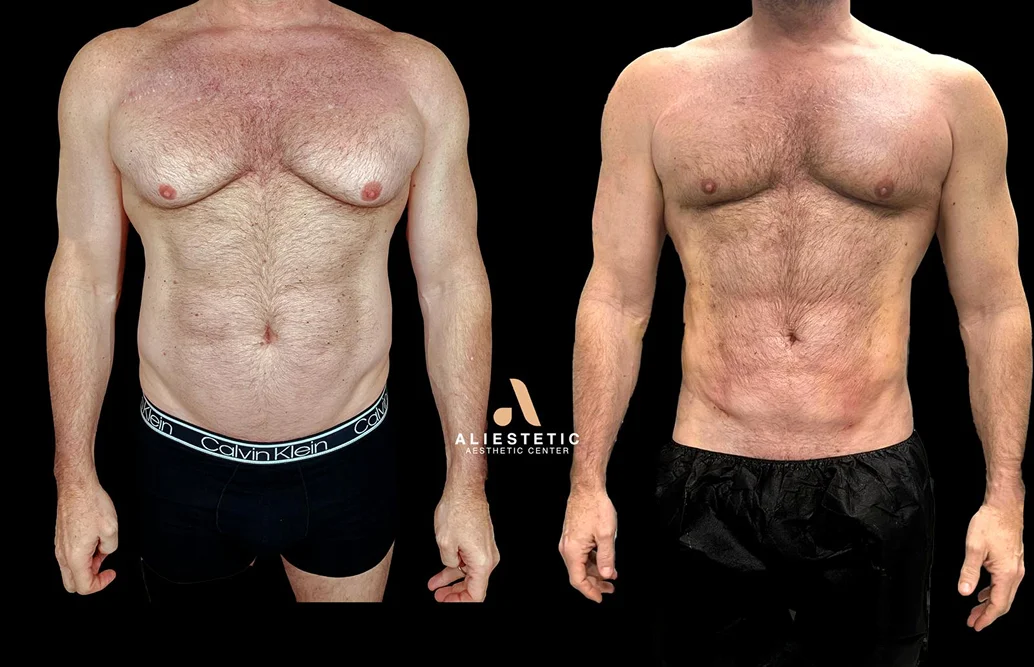
Results are individual and do not represent what any given person should expect.
Real transformations
“My chest has a masculine shape again. I feel more comfortable in my body and my clothes.” (Miguel R., 34 years old).
Results are individual: one patient’s experience does not represent what any given person should expect.
Book your appointment nowQuick facts
- Anesthesia type
- General or deep sedation, decided by the surgeon and the anesthesia provider
- Procedure time
- About 1 to 3 hours depending on grade and technique
- Compression garment
- Vest worn near continuously for the first weeks, then tapered per instructions
- Back to work
- Desk work at 5 to 7 days, physical work at 2 to 3 weeks
- Chest training
- Generally not before week 4 to 6 and only with surgical clearance
- Final result
- Three to six months as swelling resolves and scars mature
- Who operates
- An affiliated plastic surgeon. We give you the name, the Florida license number and the board certification at the consultation, before anything is scheduled
- Where recovery happens
- Compression, lymphatic drainage and follow up at the Aliestetic center in Miami
On this page1 / 10Is it gland or fat?
You know which shirts work and which do not, and how to sit at the beach. It is common and it is not a character flaw: the American Society of Plastic Surgeons counted 26,430 gynecomastia (male breast reduction) procedures by member surgeons in 2024, up two percent from 25,888 in 2023, making it the number one cosmetic surgical procedure for men in the United States.
Aliestetic is an aesthetic center in Miami, and we do not operate. The surgery is performed by our affiliated plastic surgeon.
Is it gland or fat?
True gynecomastia is glandular breast tissue, the same type found in a female breast, proliferating…
True gynecomastia is glandular breast tissue, the same type found in a female breast, proliferating under a shift in the estrogen to androgen balance. It responds to neither diet nor training, which is why men who lean out to single digit body fat still have a hard disc behind the nipple. Pseudogynecomastia, or lipomastia, is fat: soft, no defined edge, and it does respond to weight loss and liposuction.
The consequence is direct. Fat is suctioned, gland is cut out. If a clinic offers liposuction alone for a chest with real gland behind the nipple, you come out flatter with the same hard disc still there. A mixed chest needs both: liposuction to debulk and blend the periphery, and direct excision through a small incision at the lower border of the areola.
A firm one sided mass, nipple discharge or skin changes get worked up before anything cosmetic is planned: male breast cancer is rare but real.
Quick answer
How do I tell at home whether it is gland or fat? Press flat around the nipple: a firm, defined disc under the areola is gland, and soft, borderless fullness across the chest is fat. Most men have both, which is why the distinction matters for treatment, not just diagnosis, since only the fat responds to liposuction and diet.
Does it come back?
Removed gland does not grow back. Recurrence, when it happens, traces to one of three things.
Removed gland does not grow back. Recurrence, when it happens, traces to one of three things.
Tissue left behind
Restricted access through a small incision limits how much gland comes out, and a rim left at the periphery can enlarge later. It is one of the arguments for combining excision with liposuction.
An untreated cause
Anabolic steroid use is the version we see most in Miami: aromatizing compounds raise estrogen and the gland responds. Other causes include certain antiandrogens, cardiac and blood pressure drugs, some antipsychotics and acid reducers, heavy alcohol, marijuana, hormonal disorders of the testes, thyroid or pituitary, and liver or kidney disease. Operating without identifying an active cause is what correlates with a second surgery. If you are on a cycle, the conversation is about when you stop, not whether the surgeon minds.
Weight gain
The fatty component can refill even though the gland is gone.
Pubertal gynecomastia is the exception: it often resolves on its own over months to a couple of years as hormones settle, which is why surgeons wait rather than operating on a fifteen year old chest.
Does insurance cover it?
Most plans treat this as cosmetic and deny it, and most men in the United States pay out of pocket…
Most plans treat this as cosmetic and deny it, and most men in the United States pay out of pocket. It is still worth checking: insurers that do consider it look for documented pain or tenderness that interferes with daily activity, glandular rather than fatty tissue, a minimum duration, failed conservative management, and proof that reversible causes were excluded. No clinic can promise coverage, so request your plan’s written medical policy in advance.
Simon grades and what they mean for you
Surgeons classify gynecomastia by tissue volume and excess skin. The Simon classification…
Surgeons classify gynecomastia by tissue volume and excess skin. The Simon classification, published in 1973, is still the working language, and your grade drives your scar.
Grades I and IIa
Small to moderate enlargement, no excess skin. Liposuction with a small periareolar excision, minimal scar, no skin work because the skin retracts.
Grade IIb
Moderate enlargement with mild excess skin. This is the judgment zone: some surgeons rely on skin retraction plus careful contouring, others add a circumareolar skin excision with closure that controls areolar diameter.
Grade III
Marked enlargement with significant excess skin. Skin has to be removed and the nipple areola complex often needs repositioning and reduction. Longer scars, common after major weight loss.
How the process works
The consultation with your surgeon is an exam plus a history: supplements, prescriptions, alcohol…
The consultation with your surgeon is an exam plus a history: supplements, prescriptions, alcohol, steroid cycles, how long the chest has been like this, whether it is tender, whether one side differs. Answer honestly. Nobody is judging your training history; the point is to keep you from needing a second operation. Depending on what turns up, labs or an endocrine referral come before scheduling. On the day, you are marked standing up, because chest tissue moves when you lie down.
The technique
For a mixed chest the sequence starts with liposuction: tumescent fluid goes in, then cannulas…
For a mixed chest the sequence starts with liposuction: tumescent fluid goes in, then cannulas debulk the fat and feather the edges so there is no shelf where treated meets untreated tissue.
The gland then comes out through an incision along the inferior border of the areola, where the color change hides the line, and the disc is dissected off the pectoralis fascia. The critical part is what stays: a thin, deliberate layer of tissue directly under the nipple areola complex. Removing that button produces the crater deformity, a depression that is difficult to revise. Taking too much skin at the areolar border costs you in flattened nipple contour, areolar widening and thickened scarring. In grade IIb and III cases, skin excision patterns join the plan.
Recovery week by week
- 01
Days 1 to 3
The vest is on continuously. The chest feels tight, heavy and bruised, swelling peaks around day two or three, and sleeping semi upright beats lying flat.
- 02
Days 4 to 7
Bruising spreads and turns yellow, drains come out if you have them, and most men with desk jobs go back at the end of the week, still numb across parts of the chest.
- 03
Weeks 2 to 6
Walking, light cardio and lower body work return with clearance, and many men go through a phase of thinking too much was taken out. That is usually swelling. Compression tapers around four to six weeks, when chest training resumes at a fraction of your old load. Pushing this is how hematomas and stretched scars happen.
- 04
Months 2 to 6
Firmness under the areola softens, sensation returns in patches, and scars go through their red and raised phase before fading. The chest you keep is the one you see at month three or later.
Our page on compression garment stages explains how garment use changes across healing.
Real risks
Hematoma is the complication most associated with this operation, a collection of blood under the…
Hematoma is the complication most associated with this operation, a collection of blood under the skin that can require a return to the operating room. It is the reason for the vest and the chest work restriction.
Then: seroma, which may need aspiration; infection; changes in nipple and chest sensation, usually temporary; asymmetry, since the two sides are rarely identical to begin with; crater deformity from over resection; contour irregularity from under resection; skin laxity that shows once volume is gone; areolar widening, flattening or, rarely, compromised blood supply; thickened scarring; and the general risks of anesthesia, including blood clots. Revision surgery happens here, so ask any surgeon what his revision rate is and how revisions are handled financially.
What to ask before choosing a surgeon
- Verify the license through the Florida Department of Health Division of Medical Quality Assurance, whose free public search shows license status, registered address and any public discipline.
- Verify board certification with the American Board of Plastic Surgery, confirmable through Certification Matters at the American Board of Medical Specialties. Board certified and cosmetic surgeon are not interchangeable: any licensed physician in Florida can advertise as a cosmetic surgeon.
- Ask which Simon grade he thinks you are, what scar that implies, whether he plans excision, liposuction or both, and what he leaves under the nipple to avoid a crater deformity.
- Ask to see photos of men at your grade at three months or later, arms down.
What we handle at Aliestetic
We coordinate the consultation, organize the pre op steps and run the recovery program at our…
We coordinate the consultation, organize the pre op steps and run the recovery program at our center in Miami: compression, lymphatic drainage once your surgeon authorizes it, and follow up through the weeks when hematoma, seroma and asymmetry declare themselves. If you are traveling in for surgery, that is the part men forget to arrange.
Frequently asked questions
Is it gland or fat?
Press flat with your fingers around the nipple. True gynecomastia feels like a firm, rubbery, sometimes tender disc sitting directly under the areola, with a defined edge. Fat feels soft and uniform and spreads across the whole chest without a clear border. Most men have some of both. The distinction matters because fat responds to liposuction and diet, and glandular tissue responds to neither.
Will it come back after surgery?
Removed gland does not regrow. What brings the problem back is gland that was left behind, an active cause nobody looked for, or weight gain refilling the fatty portion. That is why the pre op conversation covers your medications, any anabolic steroid use, alcohol intake and hormonal symptoms. Men who go back on a cycle after surgery are the most common recurrence story in this field.
Does insurance cover gynecomastia surgery?
Most plans classify it as cosmetic and decline. Some will consider coverage with documentation of physical symptoms such as pain or tenderness, a minimum duration of the condition, confirmed glandular tissue and a failed period of conservative management, and several require that reversible causes be ruled out first. Criteria vary plan to plan. Treat coverage as something you verify in writing with your own insurer, never as a promise from a clinic.
Does it hurt?
The surgery does not, you are asleep or sedated. The first three days feel like a very hard chest workout combined with tightness from the compression vest. Sharp, focused pain on one side with swelling that grows is the pattern of a hematoma and needs an immediate call. Most men are off prescription pain medication within a few days and describe the vest as the main nuisance.
How many days of recovery will I need?
Desk work is realistic at five to seven days for most patients. Physical jobs usually wait two to three weeks. Light cardio comes back around two to three weeks, and heavy lifting and any chest work are typically held until at least week four to six with the surgeon's clearance. Full healing of the tissue is measured in three to six months.
When can I go back to work and to the gym?
Back to a desk in about a week. Back to lower body and light cardio at two to three weeks. Back to bench, dips, push ups and anything that loads the chest at four to six weeks, and even then you start at a fraction of your previous load. Pushing weights early is a good way to cause bleeding, swelling and a worse scar.
What is a crater deformity?
It is what happens when too much tissue is taken from directly beneath the areola, leaving a saucer shaped depression where the nipple sinks inward. It looks worse than the original problem and is difficult to correct. Avoiding it is a technical matter of leaving a small button of tissue under the nipple and blending the edges with liposuction rather than cutting aggressively.
Will I have drains?
Sometimes. Drains are used more often in larger resections, in higher grade cases and when a lot of tissue is removed. Many pure liposuction cases and small gland excisions do not need them. If you have them, they usually come out within several days at a follow up. Your surgeon decides based on what he finds in the operating room.
What will the scar look like?
A gland excision is typically done through an incision along the lower border of the areola, where the color change hides the line. Liposuction access points are a few millimeters. Most scars fade over months, but periareolar incisions have a documented higher rate of noticeable scarring than some other approaches, and darker skin tones carry more risk of thickened or hyperpigmented scars.
Is it worth it?
For men whose chest has changed what they wear, where they swim and how they stand in a room, the satisfaction data in this procedure is among the strongest in aesthetic surgery. It is not worth it if you are still on a steroid cycle, if you are mid way through significant weight loss, or if you expect a flat chest without accepting a scar. Those are timing and expectation problems, not surgery problems.
How should I read before and after photos?
Look for a patient at your Simon grade, with your body type and your skin quality, photographed from the same angle in the same lighting. Check that the after photo is at least three months old. Arms down in both photos, because arms up hides a lot. Chest surgery photos are easy to flatter with posture and lighting, so consistency across the pair is the tell.
Still not sure you are a candidate?
That is what the first consultation is for. It is free, there is no obligation, and you can come to Miami or start by video if you are travelling in.